That is either a coaching staff that genuinely cannot separate its options, or a coaching staff that has no interest in telling Missouri State — or Arizona State/Kentucky/LSU — which eleven are coming.
Here’s what actually moved.
The secondary reordered itself
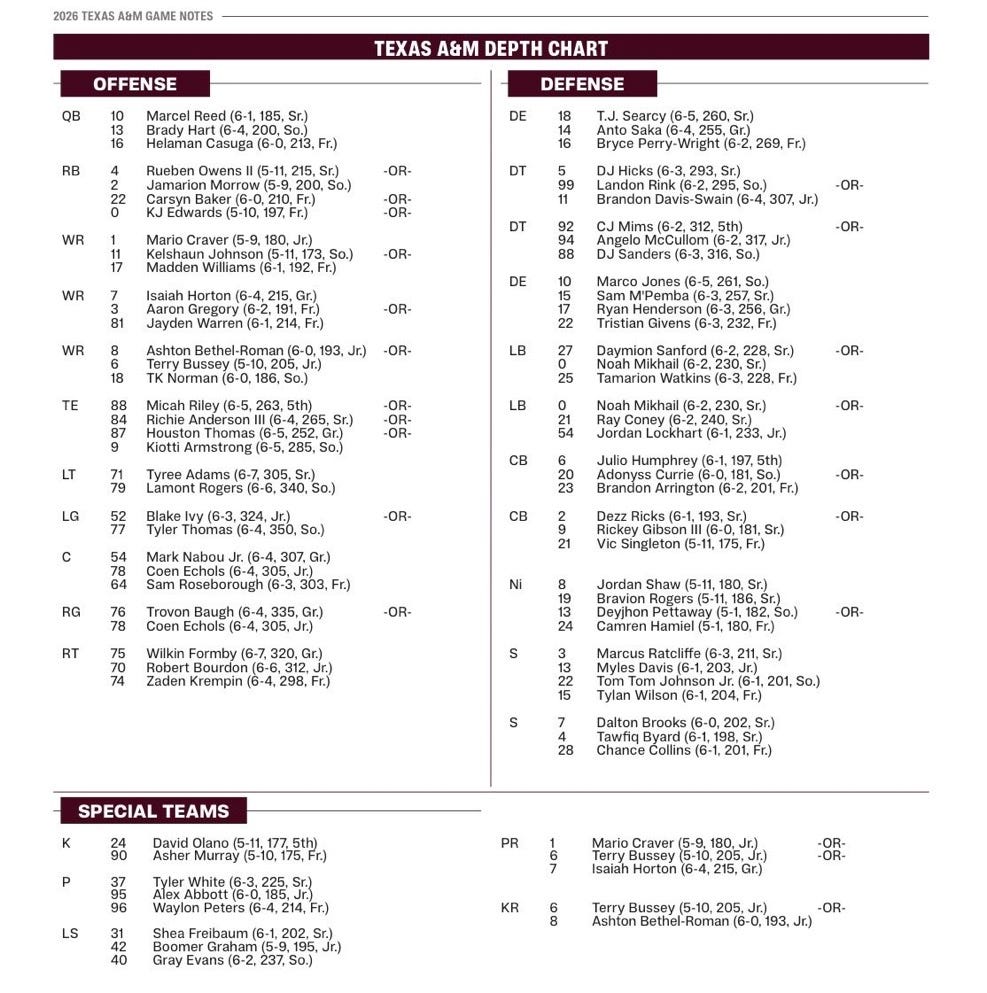
Julio Humphrey is the biggest winner on the page. He is listed as a standalone starter at cornerback — no slash, no competition, no hedge — on a chart where almost nobody else got that treatment. This is a player who played 157 snaps last season and missed the Notre Dame, Texas, and Miami games entirely. He arrived from Georgia with 658 career snaps and ten starts, spent a year buried behind Will Lee III, and now he is the only defensive back on the roster the staff was willing to write in ink.
Dezz Ricks is the other half of that story. He started all thirteen games in 2025, finished with 26 tackles and six pass breakups, and he is listed with a slash next to Tennessee transfer Rickey Gibson III. That is not a demotion. Ricks is going to play, and play a lot. But a two-year starter getting an “-OR-” is the clearest signal on the chart that Gibson’s offseason was real — and that Humphrey’s was better.
All three will be on the field. A&M plays a 4-2-5 with Jordan Shaw at nickel. The question was never whether the depth existed. It’s that the pecking order everybody assumed in April got rewritten in August.
Sixteen sacks walked out the door
A&M finished fourth nationally with 43 sacks in 2025. Cashius Howell had 11.5 of them and the SEC Defensive Player of the Year award. Dayon Hayes had 4.5. Both are gone. That’s sixteen sacks — 37 percent of the entire pass rush — replaced by a defensive end room that has never rushed a passer together.
The chart’s answer is T.J. Searcy over Anto Saka on one side and Marco Jones alone on the other.
Searcy ahead of Saka seems surprising until you look at the roles. Searcy had 31 tackles and 1.5 sacks last year — he plays the run, sets the edge, and gets his hand in the dirt on early downs. Saka came from Northwestern with three sacks and a listed 6-4, 255 frame that has been clocked near 22 miles an hour. That is a third-down player, and third-down players don’t get listed first on charts organized by base personnel.
Expect Saka to lead this team in pass-rush snaps regardless of what the two-deep says. The starter designation is a formality.
Marco Jones is the cleaner win. Two and a half sacks as a true freshman, no slash next to his name, and a defensive end room behind him that includes Sam M’Pemba, San Diego State transfer Ryan Henderson and his seven sacks, and two four-star freshmen. Jones beat all of it.
Inside, Angelo McCullom is the mover. He came from Illinois having played 295 snaps — the most of any Illini defensive tackle — with 19 tackles, three tackles for loss, and 1.5 sacks across twelve games and two starts. He is now listed second at one tackle spot behind CJ Mims, ahead of DJ Sanders, and on a chart where D.J. Hicks himself carries a slash. The interior is going to rotate five and six deep. McCullom will be in that rotation on merit.
The linebacker slash is a medical note
Daymion Sanford tore up his fibula in the spring game, left on a cart, and had surgery days later. Elko said on August 4 that he was “on course” for the opener. The slash next to his name is not a competition. It’s a snap count.
Sanford finished fourth on this team in tackles last season with 57, added 9.5 for loss, 3.5 sacks, two forced fumbles, and an interception. Healthy, he is one of the best linebackers in the SEC. The chart is telling you the staff doesn’t yet know how much of him they’ll get in September.
Noah Mikhail is the beneficiary and the story. He is listed first at one linebacker spot and second at the other — the same body holding down two jobs. Sixteen tackles and three tackles for loss as a true freshman, and he has climbed past Tulsa transfer Ray Coney, who was brought in specifically because A&M needed a veteran run-stopper after Taurean York left.
Coney is going to play. Mikhail is going to play. Sanford is going to play when he’s able.
The call: by the time A&M gets to conference play, Sanford and Coney are starting together, with Mikhail as the first man in and playing starter volume anyway. The chart won’t look like that on Saturday. It will by October.
Who’s on the field on third-and-seven
The receiver room’s only real “-OR-” sits at the third spot, between Ashton Bethel-Roman and Terry Bussey. Mario Craver and Isaiah Horton are listed clean above them.
The numbers are not close. Bethel-Roman played 603 snaps last season, started all thirteen games, and caught 24 balls for 503 yards and five touchdowns at 21.0 yards a catch. Bussey played 535 snaps and caught 18 for 195 and a score at 10.8. Sixty-eight snaps apart, two and a half times the receiving yards.
The harder number for Bussey: he went from 337 snaps in 2024 to 535 in 2025 and his production went backward — 17 catches for 216 yards down to 18 for 195. Two hundred more snaps, twenty fewer yards. Elko has attributed that to a hamstring that cost him spring practice and never fully let go, and the league still voted him preseason third-team All-SEC as a kickoff specialist off the back of 421 return yards, third in the conference.
But here is why the slash is the wrong way to read this: Holmon Wiggins has been pushing four-receiver sets all camp. In four-wide, both of them are on the field. The “-OR-” isn’t a decision. It’s a base-personnel designation that disappears the moment A&M spreads out.
So the real question isn’t who wins the job. It’s who’s out there on third-and-seven.
That’s Bethel-Roman. He is the only returning receiver on this roster who has proven he can win outside against SEC coverage, and A&M lost the production above him. Project him north of 650 snaps. Bussey lands in the same neighborhood he occupied last year — flat volume, healthy legs, and a role that finally matches what he was recruited to be.
Competition brought out the best of this offensive line
Every projection published between April and August had Coen Echols starting at left guard. LSU transfer, SEC starting experience, penciled in by everyone.
The chart has Blake Ivy there instead.
Ivy is a legitimate riser. Elko singled him out in the spring as a player who had made the jump — who understood what he was trying to do and was doing it forcibly. He went out and beat a starting SEC guard for the job, in a room where A&M brought in four portal linemen to replace four starters who got drafted. That is what a real competition produces.
And Echols didn’t lose anything. He is listed second at center behind Mark Nabou Jr. and second at right guard behind Trovon Baugh — the only player on the offensive line appearing at two positions. He’s the sixth man, and on a line replacing four NFL draft picks, the swing lineman who can play three spots is not a consolation prize. He’s insurance you’re glad you paid for.
The finished product is the most experienced group A&M could have assembled: three graduate students in Nabou, Baugh, and Formby, a senior in Tyree Adams, and Ivy as the one junior. Nabou is the lone returning starter from a line that sent Chase Bisontis, Trey Zuhn III, Dametrious Crownover, and Rueben Fatheree to the NFL. Formby brings 1,126 career snaps and 16 starts from Alabama. Baugh brings 1,460 from South Carolina.
Elko didn’t rebuild this line. He restocked it and then made them fight for it.
The return game is a luxury problem
Punt returner is listed as Mario Craver or Terry Bussey, with Isaiah Horton behind them. Kick returner is Bussey or Bethel-Roman.
Craver back there could be electric. Bussey has done it — 638 career kickoff return yards at 23.6 a pop and a preseason All-SEC nod for it.
It’s going to be Craver or Bussey, and A&M is going to pick based on the situation and the leg. That’s the correct kind of problem to have.
What the chart is actually telling you
A&M went 11-2, made the Playoff, and then lost four offensive linemen, its SEC Defensive Player of the Year, its three-year starting linebacker, and its top corner to the NFL. Elko replaced almost all of it through the portal and is now eight days from finding out whether the replacements are as good as the departures.
Twenty slashes is what it looks like when a coach has options and no evidence yet.
The evidence starts Saturday.