Every offseason, college football media runs the same play. Sometime in June, with no games to analyze and a calendar to fill, somebody publishes The Buzz List — the teams that won the offseason, the programs impossible to ignore, the hype trains leaving the station. It’s the genre’s safest bet because by the time anyone could check the work, eight months have passed, and a new list is loading. Nobody circles back. The buzz evaporates and reconstitutes the next spring, like the weather.
We circled back.
Last June, CBS Sports published its twelve teams generating the most buzz heading into 2025 — as good a snapshot of the consensus as any. So we did the one thing nobody in the genre ever does. We graded it.
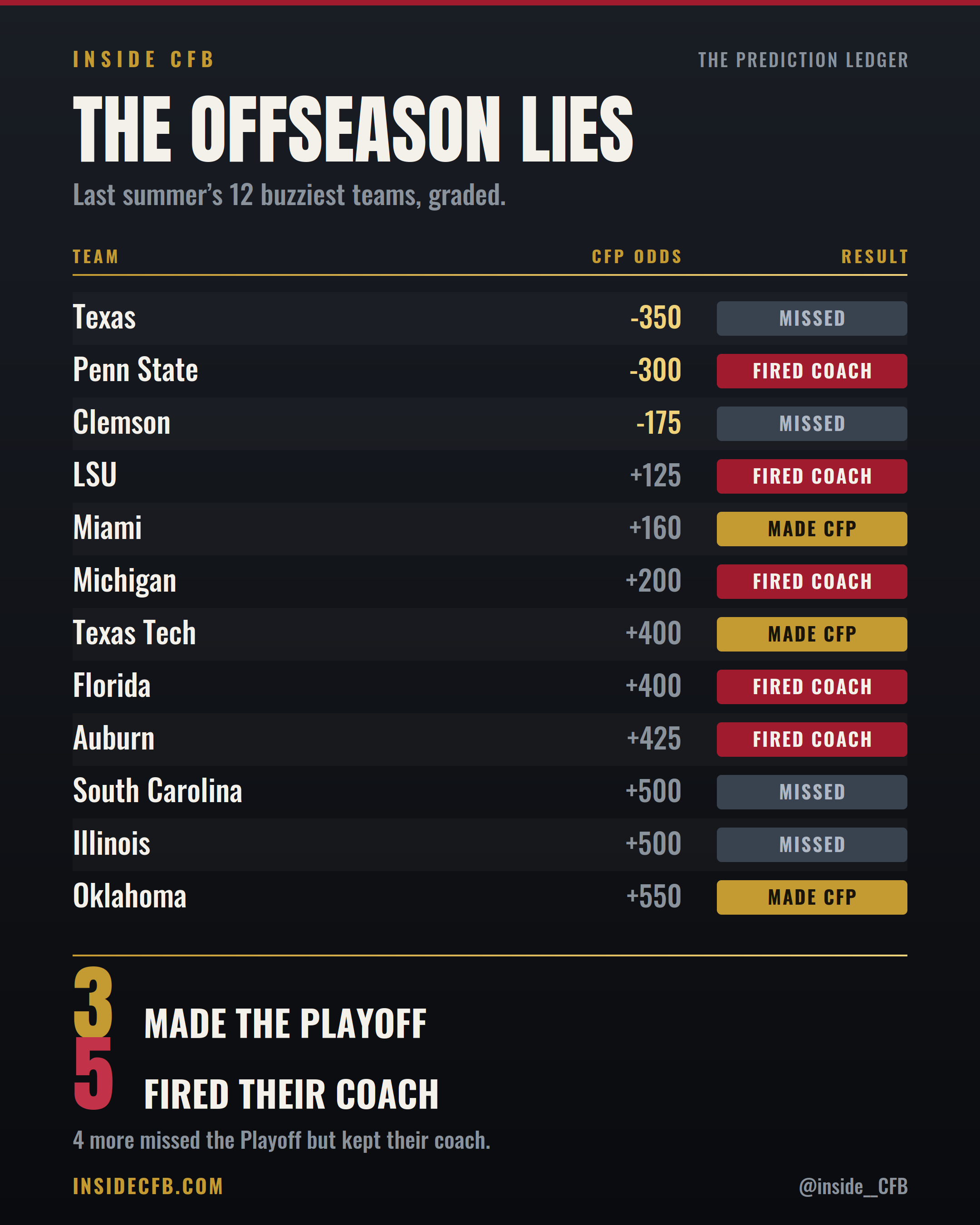
The verdict is brutal. Of those twelve anointed programs, three reached the College Football Playoff. Five fired their head coach. The most confident signal the offseason produced — these are the teams to watch — was likelier to precede a pink slip than a Playoff berth.
Start at the top, where the confidence ran highest and the wreckage is worst. The two shortest prices on the board belonged to Texas and Penn State. Texas opened at -350 — not a sleeper but a near-lock, a popular title pick with Arch Manning installed as the face of the sport. The Longhorns missed the Playoff. Penn State sat at -300, built around a veteran core that stayed for one more run. The Nittany Lions went 3-3, lost three straight, and fired James Franklin in October — eleven years undone in a single autumn.
Add Clemson (-175) and LSU (+125), and you have the four teams the market trusted most. Combined Playoff appearances: zero. Half didn’t finish the season with the same coach.
That should reframe how you read every hype list from here forward. “Loaded up in the portal” and “fired by November” turned out to describe the same teams. Franklin at Penn State. Brian Kelly at LSU, gone the night after a 49-24 humiliation at Texas A&M. Billy Napier at Florida, gone before Halloween. Hugh Freeze at Auburn, gone by early November. Sherrone Moore at Michigan, out for reasons that had nothing to do with the depth chart.
Five programs. Five offseasons that felt, in June, like ascensions. Five coaches who didn’t survive the thing the buzz promised they were building.
Rigor demands fairness: the list wasn’t all smoke. Three of the twelve cashed, and they cashed loudly. Texas Tech turned the most aggressive spending spree the sport has ever seen into a Big 12 title and a top-four seed. Oklahoma’s offensive overhaul dragged the Sooners back into the field. And Miami, at +160, didn’t just make the Playoff — it rode all the way to the national championship game.
But notice the pattern: the teams that delivered weren’t the chalk. Texas Tech (+400) and Oklahoma (+550) were priced as long shots; Miami sat sixth among the winners. The buzz was least predictive exactly where it was loudest and most expensive. Confidence and accuracy ran in opposite directions.