The wildest SEC coaching carousel in recent memory did the hot-seat watchers a strange favor: it pre-emptively fired half the candidates. Florida moved on from Billy Napier for Jon Sumrall. Auburn swapped Hugh Freeze for Alex Golesh. Kentucky replaced the Mark Stoops era with Will Stein, Arkansas turned to Ryan Silverfield, and — in the move that swallowed the entire offseason — Lane Kiffin bolted Ole Miss for LSU, handing the Rebels to Pete Golding on his way out the door.
That’s six new faces walking the SEC sidelines in 2026, and new coaches don’t get a hot seat — they get a honeymoon. So the heat this fall belongs almost entirely to a small group of holdovers who couldn’t outrun expectations. Here’s who’s sweating, what each man has to do to cool things down, and where the season likely leaves them.
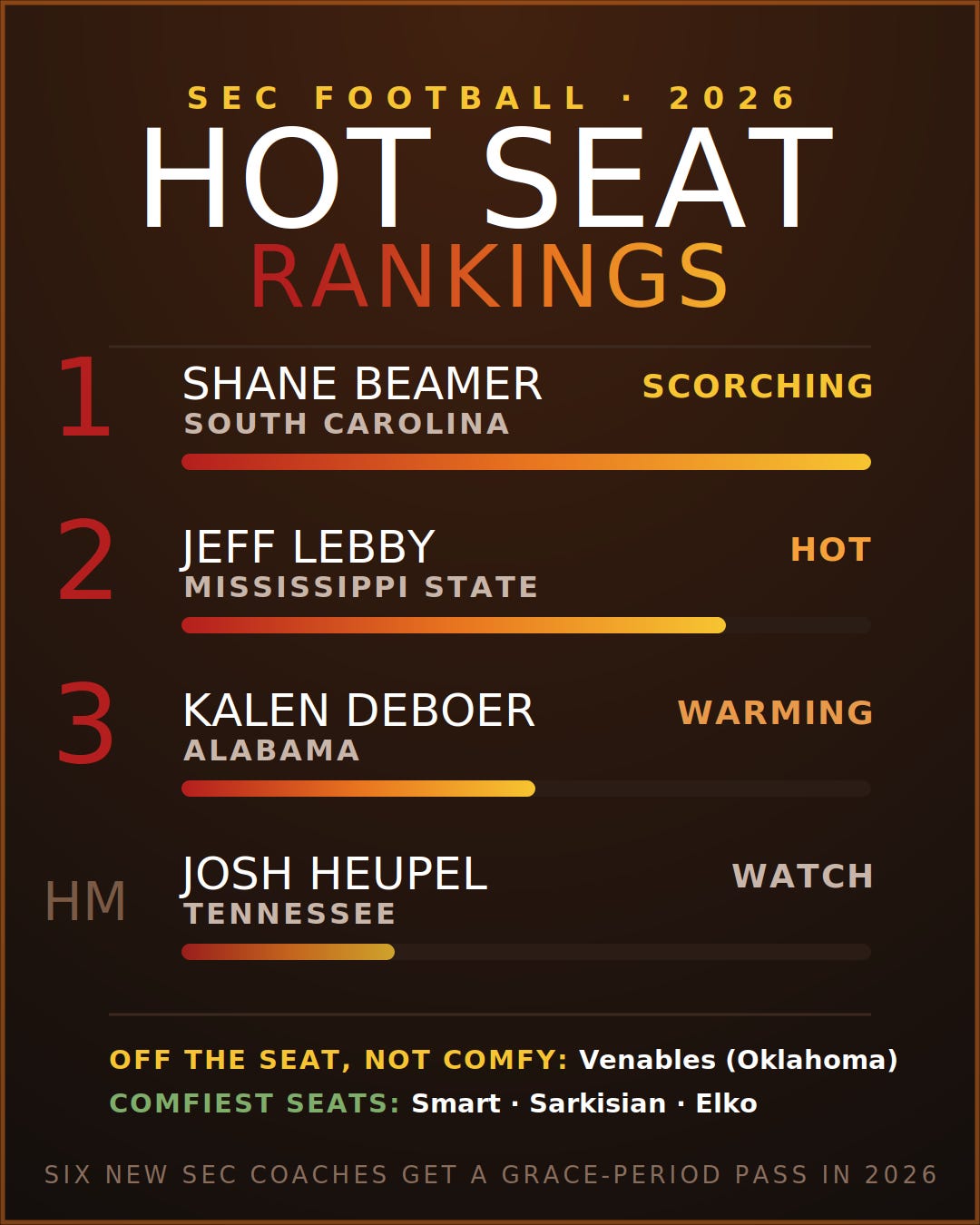
The 2026 SEC hot seat, at a glance
The Hot Seats
1. Shane Beamer
South Carolina · Year 6
Scorching
The Situation
This is the clearest hot seat in the league, and the fall was steep. After a near-miss 9-win season in 2024 that flirted with the Playoff, the Gamecocks collapsed to 4-8 — and a 1-7 SEC mark that was their worst conference showing in roughly a decade. Beamer is into year six on a contract north of $8 million a year, the kind of money that turns patience into impatience in a hurry. National lists already have him among the very hottest seats in the country.
To Cool the Seat
Get back to a bowl, and beat somebody that matters. The losses to the LSU / Alabama / Texas A&M tier of the schedule have defined the ceiling in Columbia, and Beamer responded aggressively — bringing in a new offensive coordinator in Kendal Briles and rebuilding the support staff around the unit that sank the season. With quarterback LaNorris Sellers and edge rusher Dylan Stewart both back, the talent to win seven or eight games is on the roster. He needs to actually do it.
Portal & Schedule Read
This is the part that should make Columbia optimistic: South Carolina’s transfer haul landed around No. 21 nationally, one of the better classes in the sport, and it was built to fix the exact problem that sank 2025 — the offensive line. The centerpiece is NC State tackle Jacarrius Peak, a top-10 portal prospect graded as a five-star, flanked by additions like Illinois defensive lineman Tomiwa Durojaiye, Texas running back Christian Clark and — poached from a rival on this very list — Tennessee edge Caleb Herring. Pair that with Sellers, Stewart and receiver Nyck Harbor returning and the talent reads like a clear top-25 roster.
The schedule is the catch. The non-conference slate is a gift for bowl math — Kent State and Towson are gimmes, plus the Clemson finale — but the nine-game SEC gauntlet is merciless: at Alabama, home for Tennessee, at Oklahoma, home for Texas A&M, and a November date with Georgia, a team Beamer has never beaten. The realistic read is a roster good enough for 8 wins playing a schedule that could hand it 8 losses. The bowl path runs through winning the games he should — the Mississippi State opener to the SEC slate, plus Kentucky at home, where he’s 3-1 — and stealing one he shouldn’t.
Prediction If He Survives
A 7-win bounce-back and a signature upset buys him 2027 and quiets the noise — for now. But the margin is thin: a 2-4 start with the same old marquee losses, and the midseason buyout math becomes the most-discussed topic in the state. He survives the year more likely than not, but he can’t afford a second straight step backward.
2 Jeff Lebby
Mississippi State · Year 3
Hot
The Situation
Year three is when “rebuild” stops being an excuse. Lebby’s first two seasons in Starkville read 2-10 and then 5-8, with conference records of 0-8 and 1-7 — almost no movement in the column that matters. The stat that follows him everywhere: he still hasn’t beaten a ranked opponent as a Power Four head coach. The roster has been overhauled again through the portal, so the “his players” defense is now in play.
To Cool the Seat
Two things, concretely: get the program its first signature win over a ranked team, and reach bowl eligibility at six wins. Given the brutal annual schedule, even a competitive 5-7 that includes a scalp and a couple of close SEC finishes would register as progress. The up-tempo offense has to finally translate to points against real defenses.
Portal & Schedule Read
Unlike South Carolina, Mississippi State didn’t land a blue-chip-laden class — this was another volume rebuild, with 28-plus players out the door (including six receivers and starting tackle Luke Work) and a fresh wave of transfers in to replace them. Lebby leaned on his Oklahoma roots, adding the likes of receiver Zion Ragins, lineman Isaiah Autry-Dent and defensive back Kendel Dolby, and pointed the priority at a defense that finished dead last in the SEC. The most consequential decision, though, is at quarterback: Lebby declared the offense will be built around Kamario Taylor, a true freshman whose only real audition was his first career start in the Egg Bowl. That’s upside and uncertainty rolled into one.
Now layer in the schedule, and the math gets unforgiving. The Bulldogs host Missouri, Alabama, Oklahoma and Auburn, travel to LSU, and draw a non-conference road trip to Minnesota. There is no soft stretch to bank wins. A young quarterback and a rebuilding defense against that slate makes six wins a genuine reach — which is exactly why the bar for “progress” has to be competitiveness and that elusive ranked win, not a specific record.
Prediction If He Survives
If he scrapes to five or six wins with visible offensive identity and that elusive ranked win, the modest budget and ongoing rebuild narrative likely earn him a year four. If it’s a third straight last-place-tier finish with no marquee result, this becomes the SEC’s first in-cycle buyout conversation — and Mississippi State starts taking calls.
3. Kalen DeBoer
Alabama · Year 3
Warming
The Situation
This is a different species of heat — pressure, not panic. Nobody is firing the man who replaced Nick Saban after a season that actually reached the College Football Playoff, and the buyout makes a 2026 move almost unthinkable. But the way it ended is the problem: an 11-win year that landed a Playoff berth got buried under a 38-3 humiliation by Indiana in the Rose Bowl quarterfinal. At Alabama, the standard isn’t “make the bracket,” it’s “win it” — and a blowout like that on the sport’s biggest stage is exactly the kind of result that keeps a seat warm even after a good season.
To Cool the Seat
Win a Playoff game — convincingly. DeBoer’s résumé says he can beat anyone (his record against ranked teams is among the best of any coach in the league), but the Rose Bowl made “get there” insufficient on its own. He needs to advance in the bracket and erase the memory of that 38-3 night. Beat the rivals, win the games that decide seeding, and the murmuring evaporates.
Portal & Schedule Read
Alabama played the portal selectively rather than loudly, and the roster reads accordingly: the secondary is loaded with returners, but quarterback and offensive line bring back very little experience after a steady stream of former blue-chips (running backs Richard Young and Jaylen Mbakwe, defensive back Tony Mitchell, and a wave of line depth) headed elsewhere. The headline additions are NC State running back Hollywood Smothers, USC defensive lineman Devan Thompkins and offensive lineman Kaden Strayhorn. The talent is still top-tier; the question is whether a new quarterback and a reshuffled front protect and produce at a championship level right away.
The schedule won’t grant any grace. Florida State comes to Tuscaloosa in Week 3, Georgia visits on Oct. 10, and the annual gauntlet of at Mississippi State, at Tennessee, Texas A&M, at LSU and Auburn is stacked back-to-back. For a true contender it’s navigable — but with a green quarterback, it’s also a slate that could produce two or three losses and reignite every question. What 2026 “should” look like for Alabama is 10-plus wins and a Playoff return; anything less than that, and the seat goes from warm to genuinely hot heading into 2027.
Prediction If He Survives
He’ll survive 2026 regardless; the only question is what kind of 2027 he walks into. A Playoff run with a win or two in the bracket resets him as a top-tier SEC coach and ends the noise. Another early exit — or worse, a step back out of the field entirely — turns next offseason into a full referendum.