Back to Articles

The Crown and the Kingdom: Why the SEC Is Still the Best Conference in College Football

Does the best conference have to be the one with the trophy in January? Or is the best measured by the strength of the whole league, from start to finish?

The Crown and the Kingdom: Why the SEC Is Still the Best Conference in College Football

Let’s get the tough part out of the way first. Sometimes you have to say what everyone’s thinking before someone else does.

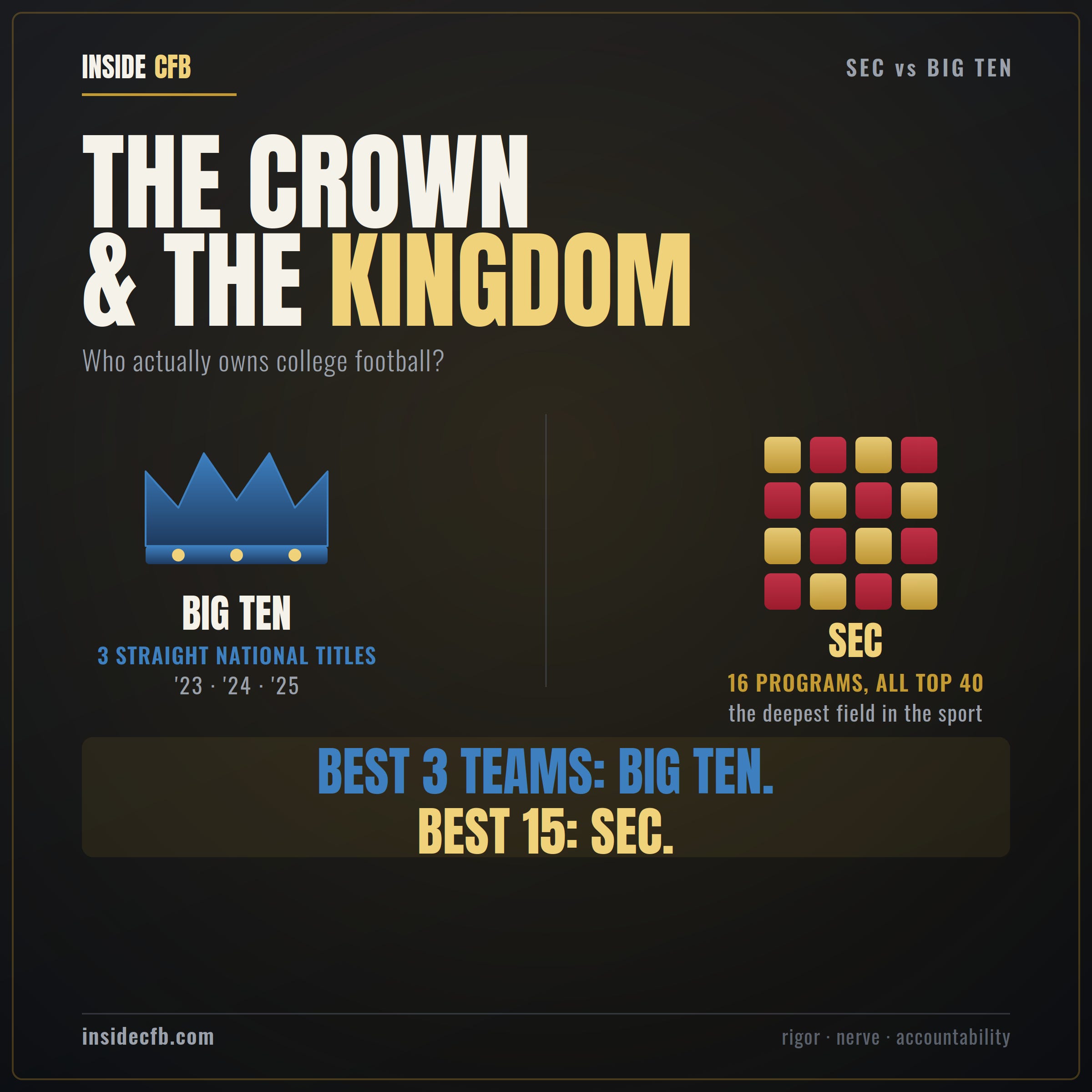
The Big Ten holds the trophy. Michigan won in 2023, Ohio State in 2024, and Indiana in 2025—three straight national championships. It’s the league’s first three-peat since the days of Franklin Roosevelt. The SEC hasn’t won it all since Georgia in 2022. Even worse, the 2025-26 postseason was rough: the SEC went 1-8 against other Power Four teams, a number too bad to ignore. The Big Ten didn’t lose to anyone else in bowl season. Right now, the crown is in the Midwest, and it’s not even close.

So here’s the real question: does the best conference have to be the one with the trophy in January? Or is the best measured by the strength of the whole league, from start to finish, and the tough schedule teams face just to make the postseason? If it’s the second, and it should be, then the answer flips.

The Big Ten has the top three teams. The SEC has the best fifteen. That’s not just a consolation—it’s the main point.

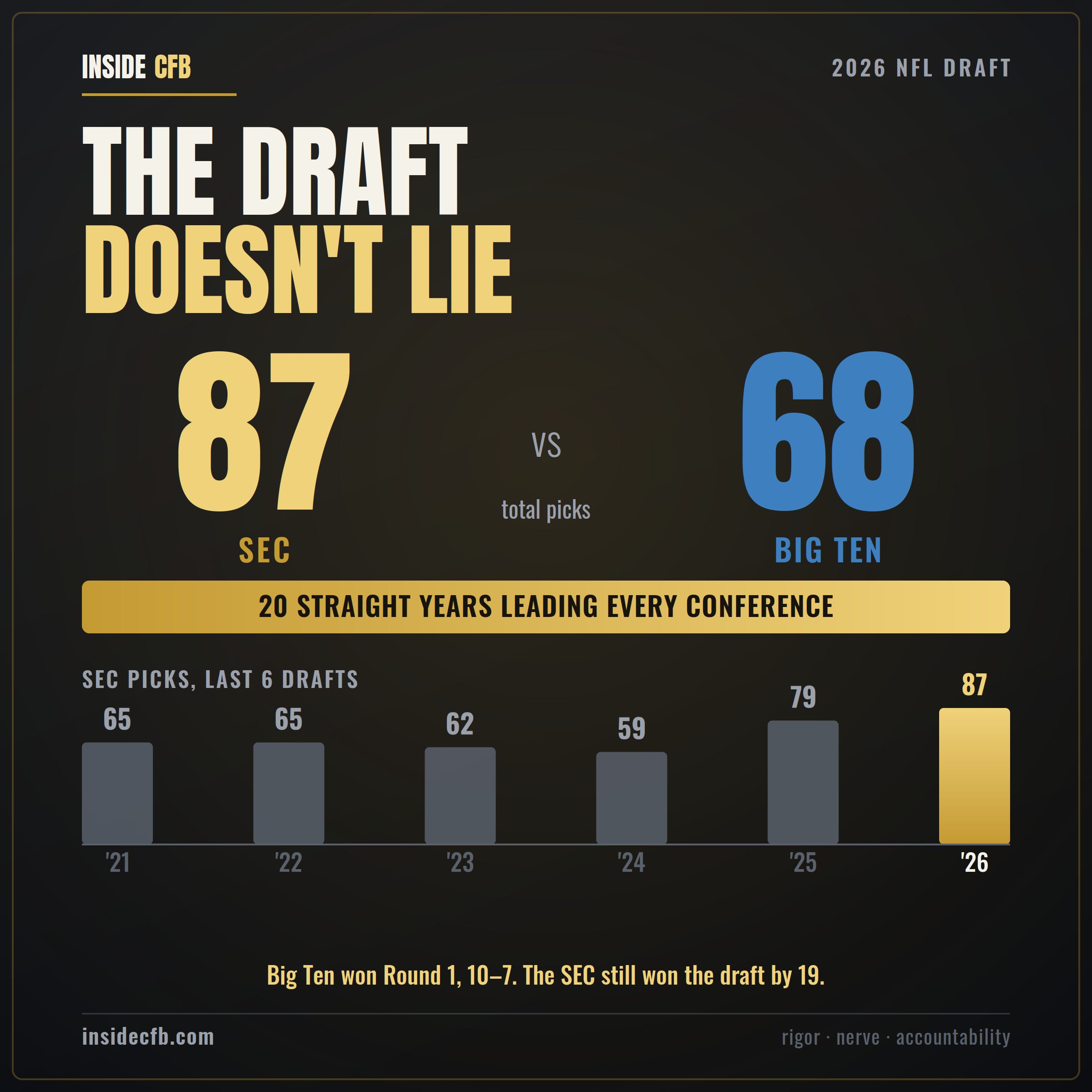
The NFL draft is the real test of depth, and the SEC just broke the all-time record.

Nothing shows how much NFL talent a league produces better than the draft. The SEC has led all conferences in total draft picks for 20 straight years. Not just most years—every single year since 2006. That’s an incredible streak in a sport known for its ups and downs.

Just look at the last six years: the SEC had 65 picks in 2021, 65 in 2022, 62 in 2023, 59 in 2024, then 79 in 2025, and an incredible 87 in 2026—the most ever by any conference. Even the lowest total, 59, would have led all other conferences. The Big Ten’s best year in that span, 71 picks in 2025, would be average for the SEC.

The 2026 draft sums up the whole debate. The Big Ten had more first-round picks for the first time since 2015—ten to the SEC’s seven. Ohio State sent four players in the first round, and Indiana’s Fernando Mendoza went No. 1 overall. That’s real star power. But over the next two days, the SEC had 87 total picks to the Big Ten’s 68. Alabama and Texas A&M each had ten players drafted, and Georgia had eight. The Big Ten produces top first-rounders. The SEC fills NFL rosters.

That’s the key difference. From 2010 through the early 2020s, the SEC had more than twice as many first-round picks as the Big Ten—about 155 to 77. The SEC has owned the top end for years, and even when the Big Ten finally had a better first round, the SEC set a new overall record. Stars win the first round. Depth wins the draft. The SEC just won the draft by 19 picks.
Nine teams meet the high standard set by the SEC.

If the draft shows where teams have been, recruiting shows where they’re going. The best way to measure talent is the Blue-Chip Ratio—the percentage of a roster made up of four- and five-star recruits over four years. No team has won a modern national title without at least 50 percent. Ohio State won the 2024 title with a 90 percent ratio, the highest ever. Talent gets you in the door, and the Blue-Chip Ratio decides who gets in.

In 2025, 18 teams met the Blue-Chip Ratio standard—19 after Oregon joined. Nine were from the SEC, five from the Big Ten. Bud Elliott, who created the metric, said the top of the Big Ten matches the SEC, but the SEC’s numbers are, in his words, absurd. Nine title-level rosters in one league. The Big Ten’s five are strong, but that’s just over half of what the SEC has.

The 2026 recruiting cycle adds some complexity. The Big Ten landed three of the top four high school classes—USC at one, Oregon at three, and Ohio State at four. Only Alabama at No. 2 kept the Big Ten from sweeping the top spots. At the top, both leagues are now competing closely. But looking further down, every SEC program—all sixteen—finished in the national top 40. There’s no weak link. The Big Ten’s best teams have caught up, but the SEC’s lowest-ranked teams are still far ahead.

The key stat: 48-1 isn’t dominance—it’s a warning sign.

This is the stat that started the whole debate, and it’s the one I stand by.

In the last two seasons, the Big Ten’s top three teams—Ohio State, Indiana, and Oregon—went 48-1 against the rest of their conference. Just one loss. The SEC’s top three by wins—Georgia, Texas, and Ole Miss—went 37-6 against the rest of the SEC. That’s six losses.

It’s easy to think that 48-1 means the Big Ten’s top teams are more dominant. But really, it shows the league is top-heavy—three powerhouses beating up on a weak middle. The SEC’s best teams lost six times to the middle of their league, not because they’re worse, but because even the SEC’s middle teams are strong enough to beat anyone.

That’s real depth, and you can see it in the standings. In the SEC, ‘any given Saturday’ isn’t just a saying—it’s the truth. The Big Ten’s top teams can boost their records against weaker opponents. The SEC’s best have to survive tough games every November just to make the postseason—and sometimes they don’t.

The regular-season receipts

Depth isn’t just an idea. It shows up in the stats, and the 2025 regular season proves it.

Seven SEC teams won at least ten games, while the Big Ten had three. Ten of the SEC’s sixteen teams finished with winning records. The SEC sent a record five teams to the twelve-team Playoff, seven to the final CFP rankings, and eight to the final AP Top 25. No other conference has filled the postseason like that. The SEC didn’t get in on reputation—it earned those spots by having the most teams truly good enough to compete.

And then it lost. A lot. Which brings us to the only honest place this argument can end.

So why did the league with the most depth struggle so much in January?

It’s because the same depth that makes the SEC so tough also wears its teams down by bowl season. Five Playoff teams means five teams spent the fall battling each other. Georgia and Ole Miss faced off in the quarterfinals because the SEC was beating itself up. The league with the hardest schedule reaches December with the most injuries, the most tired rosters, and the most players sitting out after proving themselves for the NFL draft. In a single-elimination tournament, the teams that are fresh and healthy have the advantage. The SEC’s tough schedule is a strength in November, but it becomes a challenge in January.

That’s not an excuse. Going 1-8 against Power Four teams is a fact, and Inside CFB doesn’t make excuses for results. But saying the league wore itself out and got unlucky is very different from saying the league isn’t good anymore. One is a talent issue. The other is just bad luck. Twenty straight draft wins, nine blue-chip rosters, and a record 87 picks show this isn’t a talent problem.

The call

So here’s the prediction, on the record and ready to be judged, just like every bold claim here.

The Big Ten’s title streak ends in 2026, because this kind of depth can’t be held back for long. The SEC will produce the next national champion and send more teams to the Playoff than anyone else. The crown returns to the South, and when it does, the debate between the league with the best three teams and the league with the best fifteen will end. Things will go back to how they should be.

The Big Ten built a beautiful penthouse. The SEC built a city. Penthouses give you a great view and, lately, a trophy. Cities give you everything else.

The crown is in the Midwest, but the kingdom remains in the South.