The AP Top 25 is released Monday at noon. The moment it lands, every opinion in this sport gets quietly anchored to it. Disagreement stops being conviction and starts being a matter of a few spots in either direction, and the poll becomes what everyone argues against instead of what everyone argues about. So we are going first.
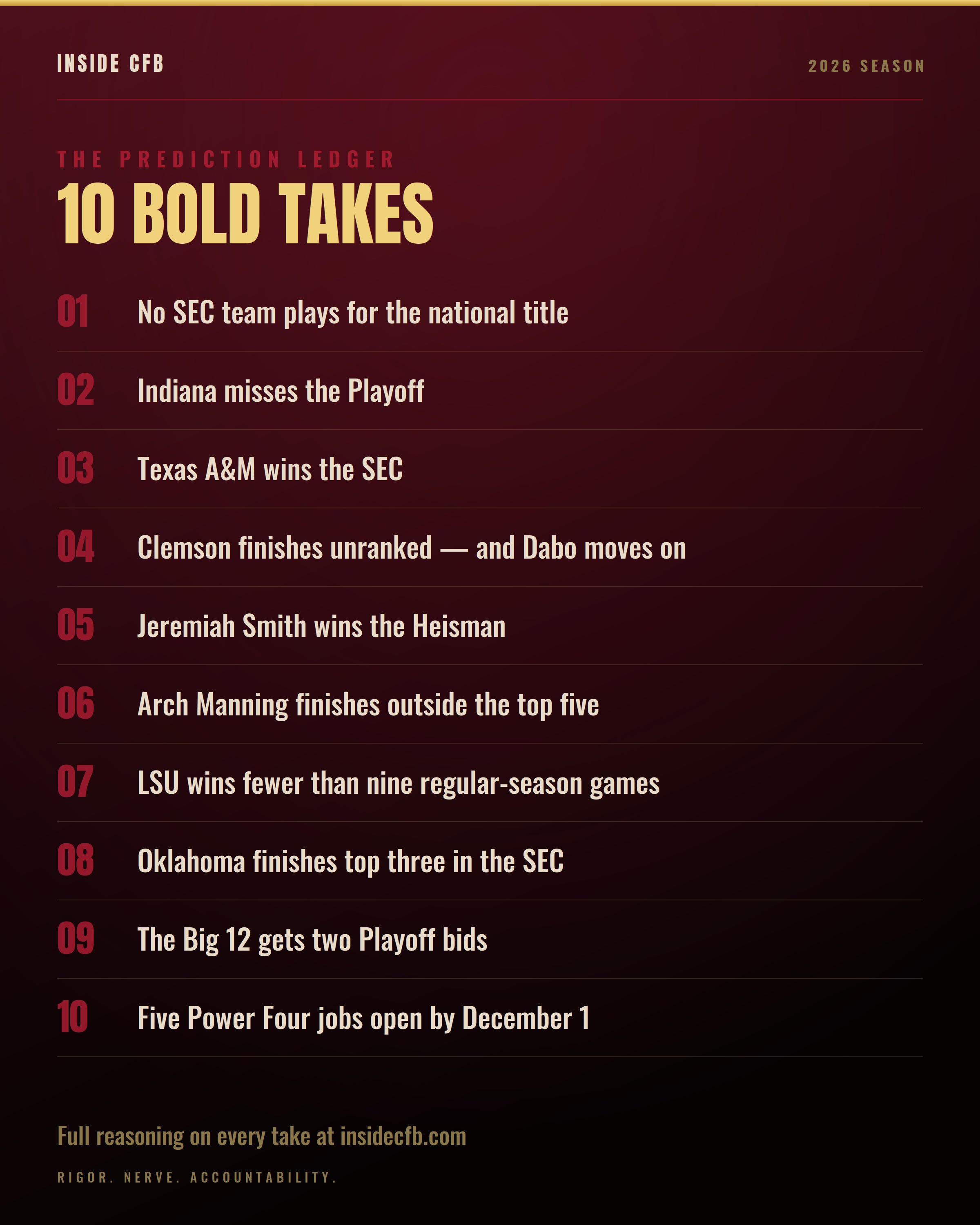
What follows are ten bold takes on the 2026 college football season. Not forecasts. There is a difference, and it matters. A forecast is what you think is most likely to happen. A take is what you think the rest of the sport has wrong. Everything below is the second kind, which means every one of them is a swing rather than a safe read of the field.
We are not going to hit all ten. Nobody hits all ten, and anyone telling you in August that they will is selling something. If half of these land, we will have had an excellent year, and the ones that miss will miss loudly and in public. That is the trade we are making on purpose. A take safe enough to survive December was not worth writing in August, which is why you will not find a single “keep an eye on” or “could surprise people” in this document. Those are not takes. They are insurance policies.
What separates this from every other list like it is that we are writing them down. SEC media members have correctly picked the conference champion ten times in the last thirty-four years, and in all thirty-four of those years, nobody went back and checked. The industry standard is to be loud in August, wrong by Halloween, and loud again the following August with a clean slate nobody asked for. The record never follows anyone around.
Ours will. These ten go into the Inside CFB Prediction Ledger today. They track through the season, they get graded when it ends, and the report card gets published with the misses listed as prominently as the hits. If we go three-for-ten, that number goes in the headline.
1. No SEC team plays in the national championship game.
Start here, because it is the call that costs us the most to make. The Big Ten has produced the last three national champions — Michigan, Ohio State, and Indiana in succession — and the SEC has not won a title since the 2022 season. Every one of those Augusts looked exactly like this one. The league loads the top ten, dominates the conversation through Labor Day, and then watches somebody else hold the trophy.
The 2026 version is no different. Ohio State opens first in the coaches poll with 38 first-place votes and returns Julian Sayin, a Heisman finalist who finished fourth a year ago, along with the best receiver in the sport. Oregon sits second with Dante Moore back after passing on a projected top-two draft slot. Indiana is the defending champion. That is three legitimate title-caliber rosters in one conference, and the SEC’s answer is a field of teams that all have to beat each other twice before they get near the final Saturday. Add in Notre Dame and Miami, and the SEC is left watching the national title at home.
2. Indiana misses the Playoff.
This one comes with the receipts attached, because we are not just saying Indiana slips. We are saying how. The Hoosiers lose to Ohio State at home on October 17, then drop a second one in November — USC on the 14th, at Washington on the 21st, or the trip to Michigan on October 24, which follows the Buckeyes by exactly one week. Take your pick. The October gauntlet of Nebraska, Ohio State, and Michigan on consecutive Saturdays is where a defending champion replacing eight drafted players finds out what it actually is.
The real problem is what happens after those two losses, and it has nothing to do with the losses themselves. Indiana’s nonconference schedule is North Texas, Howard, and Western Kentucky. There is not a single signature win available on this schedule outside of the Ohio State game, and that is the game we are saying they lose. A 10-2 Indiana team walks into the committee room with a resume whose best line is Minnesota or Nebraska.
That is how you become team thirteen. Not by being bad, but by being good in a way nobody can point to. Fernando Mendoza went first overall to the Raiders, and Curt Cignetti replaced him with Josh Hoover out of TCU, which is a genuinely good answer at quarterback and not remotely the same answer. Sixth in the coaches’ poll prices Indiana as a program rather than as a roster, and the bracket does not hand out credit for last January.
3. Texas A&M wins the SEC.
The media put Georgia first with 88 first-place votes and Texas second with 57. Texas A&M got five. The coaches poll has the Aggies eighth nationally, which is to say that the people who watch film on this roster think considerably more of it than the people who vote on narratives.
This is the deepest team in the conference, and it is not particularly close. A&M sent a record ten players to the NFL Draft and reloaded rather than rebuilt. Marcel Reed is back after throwing for 3,169 yards and 25 touchdowns, and he is one of only eight returning FBS quarterbacks with 5,000 career passing yards and 1,000 career rushing yards. His raw completion percentage of 62.1 climbs to 66.6 once you remove the 26 drops charged to his receivers, which would have ranked sixth in the SEC. That is not a quarterback who needs to improve. That is a quarterback who needed help.
He got it. Mario Craver returns after finishing sixth in the SEC in receiving yards with 917 on 59 catches, and Athlon put him on its preseason All-SEC first team alongside Marcus Ratcliffe, the only two Aggies to earn that honor. Isaiah Horton and Ashton Bethel-Roman give Reed a receiver room that belongs in the national top three. Rueben Owens II is finally healthy after a full offseason under Tommy Moffitt, Jamarion Morrow is going to force a rotation, and freshman KJ Edwards is the kind of player people start comparing to Jahmyr Gibbs before he plays a snap. Anto Saka arrives to replace Cashius Howell, who led the SEC in sacks, after producing 12 sacks and three forced fumbles at Northwestern.
The offense scored 38.1 points a game last year, tenth nationally, and gained 465.1 yards a game, fifteenth. It did that while starting 11-0 for the first time since 1992. Four transfer starters rebuilt the offensive line, and the room behind them is deep enough that Adam Cushing has real choices rather than emergencies. Everything that broke in November was fixable, and every fix has been made. The gap between where A&M is ranked and where A&M is picked is the largest inefficiency in this league, and our bet on exactly that.
4. Clemson finishes the season unranked, and Dabo Swinney is coaching somewhere else in 2027.
Clemson opened 23rd in the coaches poll. That is the program’s lowest preseason position since it went unranked in 2011, and it comes directly after a season that began with a top-six ranking and ended 7-6. One year like that is variance. Two is a verdict. The schedule offers no soft landing either, since the Tigers open against Lane Kiffin’s LSU in a game that will be treated as a referendum before kickoff.
The second half of this call is the interesting one, and it is not the one everybody assumes. Swinney built a program from nothing into two national titles and a Hall of Fame resume, and men with that resume do not usually get run out of town. They get tired of the town. The sport he won in no longer exists, the buyout conversation cuts both ways, and there is a version of this where Clemson does not fire Dabo Swinney at all — where Swinney looks at a roster construction model he has openly disliked for five years, decides he would rather build the second act on his own terms, and goes and does it somewhere with a checkbook and no ghosts. Either way, the answer to who is coaching Clemson in 2027 is somebody else.
5. Jeremiah Smith wins the Heisman Trophy.
Smith finished sixth in the 2025 voting with 87 catches for 1,243 yards and 12 touchdowns, and he now owns back-to-back thousand-yard, ten-touchdown seasons before his junior year. He is the best player in college football, and it is not an especially close argument.
The case against him is structural rather than personal. Quarterbacks have taken 16 of the last 20 Heismans, and no receiver has won since DeVonta Smith in 2020. But the award also tends to follow the best player on the best team, and Smith is going to spend the fall catching passes from a returning finalist on the preseason No. 1. Every condition that has ever produced a receiver winner is present at once.
6. Arch Manning does not finish in the top five of Heisman voting.
The path here is simple, and it does not require Manning to play badly. Texas loses two games. That is it. That is the whole call.
In a normal year, a quarterback can lose two and still finish third, because there are three or four names on the ballot and one of them has to be him. This is not a normal year. Sayin was a finalist. Carr is the co-favorite. Dante Moore came back to Oregon. John Mateer is healthy. Trinidad Chambliss is still in Oxford. Marcel Reed is throwing to the best receiver room in the country. There are too many quarterbacks having good seasons for a two-loss Texas team to push its own into the top five, and Manning enters as the betting favorite for a second consecutive preseason on the strength of a name rather than a 2025 that justified it. He will win a lot of games and finish eighth.
7. LSU wins fewer than nine regular-season games.
Read the schedule and the call makes itself. LSU opens against Clemson on September 5. Two weeks later, Kiffin walks back into Vaught-Hemingway to face the program he left, in what will be the loudest and most personal environment of anybody’s season. The week after that, Texas A&M comes to Tiger Stadium. Then it is a road trip to Kentucky, a road trip to Auburn, Alabama at home on November 7, Texas at home on November 14, a road game at Tennessee — the other program Kiffin walked out on — on November 21, and a trip to Arkansas to close.
That is Clemson, Ole Miss, Texas A&M, Alabama, Texas, and Tennessee, with three away from Baton Rouge and two doubling as revenge games against Kiffin personally. Splitting those six would be a respectable year. Splitting them puts LSU at nine wins only if it runs the table everywhere else, and first years under new staffs do not run tables. The talent will look right in September. The record in November is what gets graded.
8. Oklahoma finishes in the top three of the SEC.
The media picked the Sooners seventh, which is a strange place to put a team coming off ten wins and a Playoff appearance. Brent Venables has fielded one of the nation’s best defenses in essentially every year he has been in Norman, and this one is loaded again. Oklahoma landed ten preseason All-SEC selections after landing three a year ago. The defense is not the question, and it hasn't been for a while.
Everything rides on the other side of the ball, and specifically on two things. John Mateer has to stay healthy, because the version of this offense with a fully healthy Mateer and the version without him are two different teams, and Oklahoma already lived through that experiment. And the Sooners have to run the football well enough that Mateer is not asked to win games by himself. Elite defense plus a functional run game plus a healthy quarterback equals a top-three finish in this league. Take away any one of those three, and it is seventh, exactly where they were picked. This is a bet on two specific variables, not on vibes.
9. The Big 12 gets two Playoff bids.
Texas Tech went 12-2 and won the league. BYU also went 12-2 and watched the bracket get built without them. Last December, the committee told the Big 12 that a two-loss conference season was worth exactly one seat.
Here is the structural detail that makes this year different: Texas Tech and BYU do not play each other. There is no head-to-head result for the committee to hide behind, no elimination game that conveniently sorts them, and no way to argue one beat the other. If both arrive in December with one loss, the committee has to either take them both or explain in public why it is splitting a hair that does not exist. It blinked on that argument once already. It does not get to make it twice.
10. At least five Power Four head coaching jobs come open by December 1.
Start with Dave Aranda, because he is the clearest case in the country. Aranda is 36-37 across six years at Baylor with one winning season since the 2021 Big 12 title, and he went 5-7 and 3-6 in the league last fall. CBS Sports has him as the most vulnerable coach in the Power Four. He survived last cycle largely because the athletic director’s office was in turmoil, not because anybody made an affirmative case for him. He spent the offseason making a last stand — DJ Lagway in the portal, Joe Klanderman hired to rebuild the defense — and it is genuinely good work. It is also work that has to produce roughly eight wins immediately, and Baylor opens against Auburn in Atlanta.
Behind him, the list writes itself before a snap has been played: Jeff Lebby, Bill O’Brien, Deion Sanders, Scott Satterfield, Greg Schiano, Mike Norvell, Luke Fickell, Shane Beamer. That is eight names on consensus hot-seat lists in August. Buyouts keep shrinking relative to what programs already spend on rosters, and patience shrinks with them. Five is the floor, not the ceiling, and the number that ends up on this line in December will probably embarrass the people who called it aggressive today.
The Grading Standard
Each of these ten resolves as a yes or a no against final results. There is no partial credit, no reinterpretation, and no rewording after the fact. A take that was close is a take that was wrong, and some of these are going to be wrong.