Arizona
Can a defense that lost its best players hold up on a brutal road slate?
Brent Brennan turned a 4-8 disaster into a 9-4 season, and the offense that drove it is back: quarterback Noah Fifita threw for a career-best 2,963 yards with 26 touchdowns against just five interceptions, spreading scores to ten different targets and becoming Arizona’s all-time leader in passing touchdowns (70). He’s efficient, experienced, and the reason the Wildcats won six of seven at home.
But the specific problem is defense. Arizona’s pass rush finished dead last in the Big 12 with just 10 sacks, and now the secondary that masked it has been gutted — All-Big 12 defensive backs Treydan Stukes and Dalton Johnson both went to the NFL. That’s a unit replacing its best players while the schedule hands it a gauntlet: at BYU, at Texas Tech, at Kansas State. Arizona barely got pressure with its veterans; can a rebuilt front and secondary survive three road trips to the league’s heavyweights? If Fifita is good enough to win shootouts, Arizona stays in the upper half. If the defense can’t get off the field away from Tucson, last year looks like the ceiling. My lean: a step back in record against a much harder draw, somewhere around 7-5.
Arizona State
Where does the offense come from now that nearly all of it is gone?
Two years ago, the Sun Devils were picked last and won the league. The bill is now due, and it’s enormous. Receiver Jordyn Tyson, an All-American, went eighth overall in the NFL draft; leading rusher Raleek Brown (1,141 yards, first-team All-Big 12) transferred to Texas; quarterback Sam Leavitt left for LSU. ASU returns just three of the 25 players who started at least six games last fall — its top three pass-catchers alone accounted for roughly 40% of the receiving production. Retaining coach Kenny Dillingham through the carousel was the single most important thing that happened to this program all offseason.
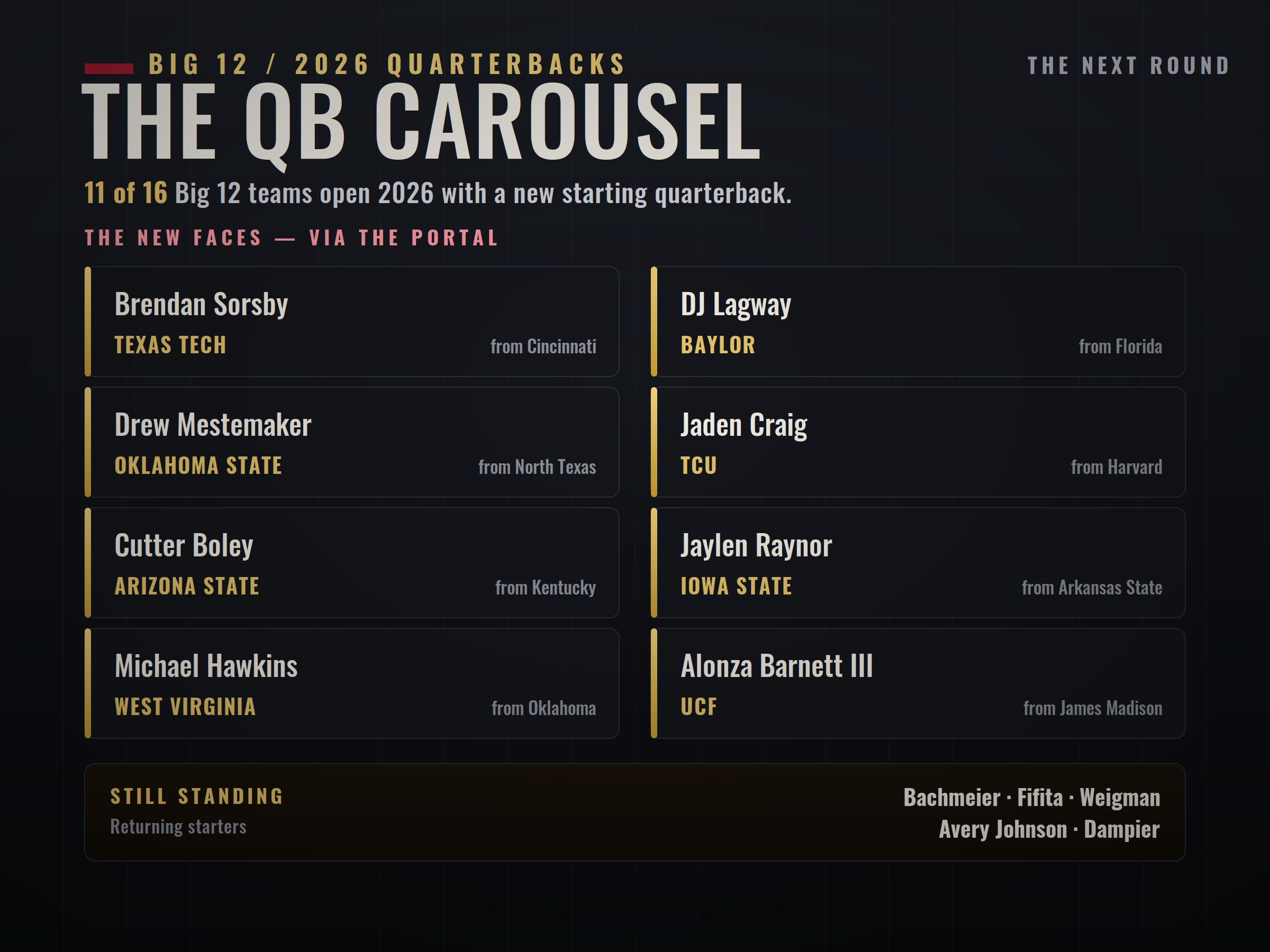
The on-field question is simply points. Even in 2025, the Devils were 8-0 when scoring more than 20 and 0-4 when they didn’t — and the players who made 20 easy are gone. Dillingham reloaded the receiver room around Omarion Miller, the former Colorado standout who became the highest-rated transfer addition in program history, and the quarterback job is an open competition between Kentucky transfer Cutter Boley and young Jake Fette. There’s coaching here, and the schedule has soft spots, so a bowl is reachable. But asking a near-entirely new offense to recreate a championship attack is a tall order. This feels like a reset year.
Baylor
Does Dave Aranda survive the season?
This is now a job-security question, and the 2025 evidence is damning precisely because the offense was so good. Sawyer Robertson was a genuine star — he led the nation in passing yards (306.8 per game) and finished second nationally with 31 touchdown passes — and Dave Aranda flatly admitted, “Without Sawyer, we’re not able to win any games.” And yet Baylor went 5-7, because the defense couldn’t get a stop. When your quarterback is one of the best in America and you still miss a bowl, the problem is the head coach’s side of the ball.
Now Robertson is gone, and the swing-for-the-fences replacement is DJ Lagway, the former five-star who flamed out amid injuries and inconsistency at Florida but lands in a system that has historically inflated quarterback numbers. The season — and Aranda’s job — comes down to two things: whether Lagway is excellent right away, and whether a defense that sank a star-led team can finally hold up, starting with Auburn in the opener. A third straight underwhelming year almost certainly ends the era. My lean: the offense scores enough to stay interesting, the defense lags again, and Aranda spends November on the hot seat.
BYU
Does Bear Bachmeier have enough around him to push past Texas Tech — and finally get the Big 12 the respect it’s owed?
BYU is the league’s best argument. The Cougars went 12-2, beat Utah and Arizona, walloped TCU, won the Pop-Tarts Bowl, and still got left out of the Playoff in favor of a three-loss Alabama — a snub about branding, not football. The encore should be better, and the numbers back it. Bear Bachmeier, the Big 12 Offensive Freshman of the Year, returns after a poised true-freshman season: 2,708 passing yards, 14 touchdowns, just six interceptions, plus 527 rushing yards and 11 scores — 3,560 total yards and 26 touchdowns. He’s joined by LJ Martin, the Big 12 Offensive Player of the Year, who led the conference with 1,305 rushing yards and 12 touchdowns at 5.5 a carry and is now chasing BYU’s all-time rushing record. The defense projects as one of the conference’s best.
The question is the gap between very good and great. Bachmeier protected the ball early before the inevitable freshman turnovers crept in late, and that’s the growth area as a sophomore. The schedule helps enormously — there’s no Texas Tech on the regular-season slate — so the path to a Playoff bid is cleaner than the team it’s chasing. If the defense is as good as advertised and Bachmeier takes the expected step, BYU isn’t just pushing past Texas Tech; it’s the most complete team in the conference. This is my pick to win the Big 12.
Cincinnati
Can the Bearcats stop folding down the stretch — and replace Brendan Sorsby?
Cincinnati has a November problem. The Bearcats started 2025 at 7-1 and then lost five straight to close, a collapse driven by a brutally back-loaded schedule — and the 2026 slate is built the same way, with the easy games early and the gauntlet late. So the first question is whether Scott Satterfield’s group can finally finish a season instead of melting in the home stretch.
The second is at quarterback. Brendan Sorsby left for Texas Tech, taking 45 touchdown passes over two seasons and more than 1,000 career rushing yards with him, and the keys now go to JC French IV, who has to prove he can run a Big 12 offense. There are too many moving parts on the roster and staff to feel confident this is the year it changes. The talent is good enough for another bowl, but “good enough for a bowl, then a late swoon” has become the Cincinnati pattern, and Satterfield badly needs a season that bends the other way. My lean: 6-6 or 7-5, and another tense finish.
Colorado
Can Deion Sanders rebuild the trenches — after they got worse, not better?
The circus has quieted in Boulder. Shedeur Sanders and Travis Hunter are in the NFL, the cameras have moved on, and what’s left is a program that fell from nine wins in 2024 to 3-9 in 2025 and lost its final five games by an average score of 40-15. Deion Sanders is 16-21 overall, sits on the hottest seat in the league by most measures, and — fairly — needs only a decent season to keep it.
The problem is the lines, and they regressed this offseason. Colorado’s run defense was among the worst in the entire country, and then the Buffs lost their best blocker, five-star left tackle Jordan Seaton, to LSU on a record offensive-line deal, and a starting defensive lineman, Brandon Davis-Swain, to Texas A&M — on top of both starting receivers leaving. Thirty-plus players hit the portal; thirty-one transfers came in. Redshirt freshman Julian Lewis, the former blue-chipper who flashed late (589 yards, four touchdowns, no picks in limited work), is the anointed starter under new coordinator Brennan Marion, and Sanders — whose own health has rebounded for 2026 — has to rebuild both lines essentially from scratch. (One name for the locals to file away: incoming freshman running back Cam Newton, who may not see heavy carries as a true freshman but is a name to watch down the road.) Bowl eligibility would be a genuine win. Anything less, and the offseason gets loud again.
Houston
Can Conner Weigman finally win the big one?
Houston’s 10-win 2025 was the quietest big season in the country — a 10-3 finish, a No. 22 final ranking (the program’s first since 2021), a Texas Bowl win over LSU, and a perfect 6-0 record on the road, the only such mark in FBS. Conner Weigman, the former five-star whose Texas A&M career stalled, got it back on track in his hometown: 25 touchdowns, the highest efficiency rating of any returning Big 12 quarterback (147.1), plus 700 yards and 11 scores on the ground. Top target Amare Thomas returns, and five-star freshman Keisean Henderson — the No. 1 quarterback recruit in the class — waits in reserve.
But here’s the catch, and it’s the whole question: Houston’s one real test was a 35-11 home blowout by Texas Tech, a game Weigman left with a concussion, and the team’s profile is built on beating everyone it was supposed to beat (the Cougars were 6-0 when Weigman didn’t turn it over, 1-2 when he did). Weigman has yet to prove he can win the game that defines a season — the very thing that haunted him at A&M. Houston draws Texas Tech again in 2026. If Weigman clears that bar, this is a genuine Big 12 contender and the league’s most underrated team. My lean: another nine or ten wins, with the ceiling decided by whether he finally beats a heavyweight.
Iowa State
How far does the bottom fall after the great teardown?
This is the starkest situation in the league. Matt Campbell, the winningest coach in program history, left for Penn State in January, and the roster didn’t erode so much as evaporate — more than 40 players hit the portal, two dozen following Campbell to Happy Valley, including three-year starting quarterback Rocco Becht. New coach Jimmy Rogers arrives from Washington State (7-6 in his lone season there) and has essentially been asked to assemble a Big 12 roster from scratch in nine months, importing a wave of his old Washington State and South Dakota State players to do it.
So the only honest question is how bad it gets, and how fast Rogers stabilizes things. Arkansas State grad transfer Jaylen Raynor is trending toward the starting job, and there’s no shame in a down year given the circumstances. The schedule offers one mercy — no Texas Tech, Houston, or Arizona State — but a step back is unavoidable. This is a multi-year project, and 2026 is about competitiveness and culture, not the standings. My lean: a tough, lesson-filled four- or five-win season that sets up the actual rebuild.
Kansas
Can Lance Leipold get the offense breathing again with a brand-new quarterback?
The shine wore off in Lawrence. After Leipold engineered one of the sport’s best turnarounds, the Jayhawks have now posted back-to-back losing seasons, including a stagnant 5-7 in 2025 that wasted the buzz of a refurbished stadium. The math was brutal: Kansas went 5-0 when it scored more than 21 points and 0-7 when it didn’t, and the defense surrendered nearly 30 points per game (29.4) in Big 12 play. Both sides of the ball broke at once.
The fix starts with scheme and a new triggerman. Andy Kotelnicki is back as play-caller — a real upgrade who should restore the creativity that once made Kansas fun — but he’s working with an unproven quarterback in Isaiah Marshall and reshuffled skill talent, with Jalon Daniels finally out of eligibility. Leipold remains one of the better coaches in the league, which is exactly why a third straight losing season would land hard. The pieces for a bounce-back are here; it all hinges on whether the new quarterback is ready. My lean: a return to bowl eligibility, but only if Marshall is.
Kansas State
Is Collin Klein the right man to turn a good program into a great one?
Kansas State is the league’s most interesting buy-low. The Wildcats were a popular preseason pick in 2025 and instead slogged to 6-6, undone by a 1-3 start and five one-score losses — equal parts disappointing and encouraging, because the margins were paper-thin. Chris Klieman retired afterward, citing health, and handed the program to Collin Klein, the former K-State quarterback and Heisman finalist who just spent two years coordinating a Texas A&M offense that reached the Playoff. He’s keeping play-calling for himself, and it’s the best feel-good story in college football: the hometown hero comes home.
The honest caveat — and Aggie fans who watched that offense up close will tell you — is that Klein’s playcalling at A&M was uneven and often divisive, an attack that leaned on talent and a dynamic quarterback more than scheme, with red-zone and rhythm issues that frustrated a fan base expecting more. The good news for K-State is that he doesn’t have to reinvent much: dual-threat quarterback Avery Johnson (2,385 passing yards, 18 touchdowns, plus 477 yards and eight scores rushing) returned for his senior year specifically to play for the coach who recruited him, and the roster just needs a tougher defense and a more grinding offense. If the close losses flip, the schedule is soft enough to chase ten wins and an at-large Playoff bid. This is my dark-horse pick to surprise the country.
Oklahoma State
Can Drew Mestemaker prove he’s a first-round pick at the Power Four level?
Rock bottom arrived fast in Stillwater: Mike Gundy was fired three games into a 1-11 season that pushed the Cowboys’ Big 12 losing streak to 18 games, and the offense finished 130th nationally. New coach Eric Morris arrives from North Texas and brought the engine of the country’s most prolific attack with him — quarterback Drew Mestemaker, a former walk-on who won the Burlsworth Trophy, was named AAC Offensive Player of the Year, and led the nation in passing (roughly 4,300 yards and 34 touchdowns against seven interceptions on 68% accuracy), once throwing for 608 yards in a single game — plus running back Caleb Hawkins and receiver Wyatt Young.
So the offense will go from unwatchable to dangerous overnight; the real question is the player. Mestemaker put up video-game numbers in the American, and 2026 is the proving ground for whether that translates against Big 12 defenses well enough to make him the first-round pick the hype suggests. The catch elsewhere: coordinator Skyler Cassity inherits a far heavier rebuild on a defense with little to work with, and a schedule featuring Oregon plus Big 12 road trips to Kansas State, Houston, Arizona State, West Virginia, and Iowa State means the record may lag the improvement. There’s no title run here, but the Cowboys are about to be the team nobody wants to schedule — and Mestemaker is the reason. My lean: a five-win leap, several shootout upsets, and a quarterback who climbs draft boards.