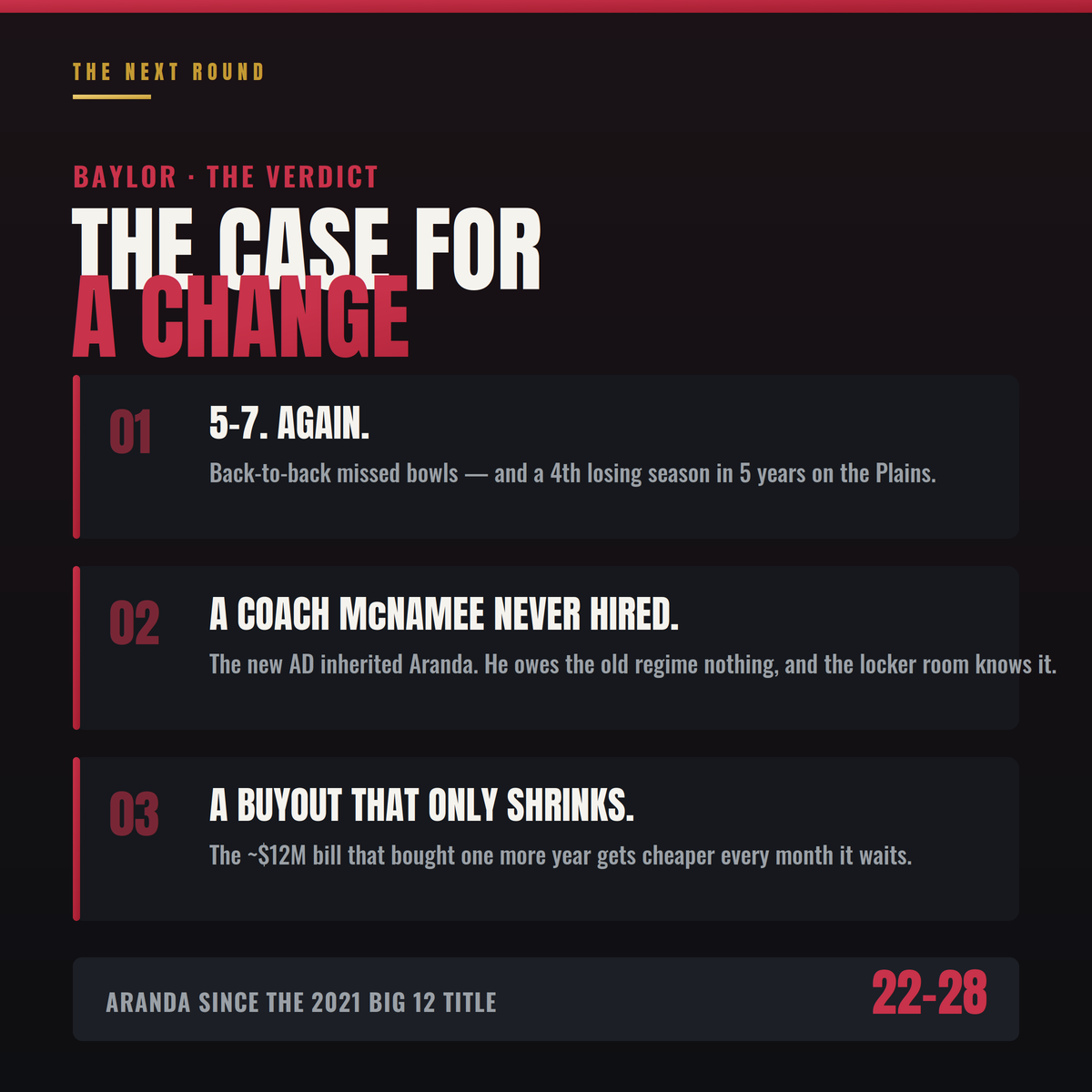
Dave Aranda should not have a job. That is not an insult — it is the consensus position of nearly every national outlet that ranked offseason hot seats, and it is a defensible read of the math. Aranda is 36-37 overall at Baylor and a brutal 22-28 since the night his 2021 team won the Big 12 and beat Ole Miss in the Sugar Bowl. Strip out that 12-2 miracle and his Baylor tenure is a sub-.450 coach who has now posted three losing seasons in four years, the latest a 5-7 face-plant that missed a bowl and finished 3-6 in the league.
He has a job anyway, and how he kept it tells you everything about the stakes of 2026.
How Aranda survived
When Baylor stumbled to 5-5 last November, the program lost its athletic director before it lost its coach. Mack Rhoades — who had also been chairing the College Football Playoff selection committee — abruptly resigned. Many in Waco assumed Aranda was next. Instead, president Linda Livingstone stepped in, conducted what the school called a “comprehensive review,” and announced Aranda would return for a seventh season.
Read the stated reasons and you understand this was a stay of execution, not a vote of confidence. Livingstone cited the desire for stability while the school searched for a new AD, the need to protect the locker room and a ranked recruiting class, and — the part nobody said out loud but everybody understood — money. Aranda is making $4.7 million on a contract that runs through 2029, with a buyout the Fort Worth Star-Telegram’s Mac Engel pegged in the neighborhood of $12 million. In the current revenue-sharing and NIL crunch, that’s a check Baylor decided it would rather not write in a transition year.
New AD Doug McNamee — a Baylor grad who came back from running Field & Stream and, before that, the Gaines family’s Magnolia brand — was hired in early December. He’s said all the diplomatic things (”we’re in it to win it”), but he didn’t hire Aranda, and he owes him nothing. That is the definition of a put-up-or-shut-up season. If 2026 goes sideways, McNamee gets to make his first big swing as athletic director, and the buyout math only gets easier with each passing month.
What changed: a new defense and a near-total roster flip
Give Aranda credit for one thing — he didn’t sit still. The single biggest move was finally taking his hands off the defense. After years of calling it himself (the unit cratered to 87th nationally in total defense in 2025, surrendering 392.1 yards per game and a ghastly 32.6 points per game, 122nd in the country), Aranda hired Kansas State’s Joe Klanderman to run it. Klanderman spent six seasons coordinating one of the Big 12’s most consistent defenses in Manhattan, and he inherits a fixable disaster: Baylor’s run defense allowed 197.2 yards per game and 30 rushing touchdowns last fall, a number only Colorado was worse than in the entire conference.
Then came the portal. Baylor lost 23 players and replaced them with roughly 22 incoming transfers, a near-complete teardown of the two-deep. The losses were severe and they hit the spots that hurt most:
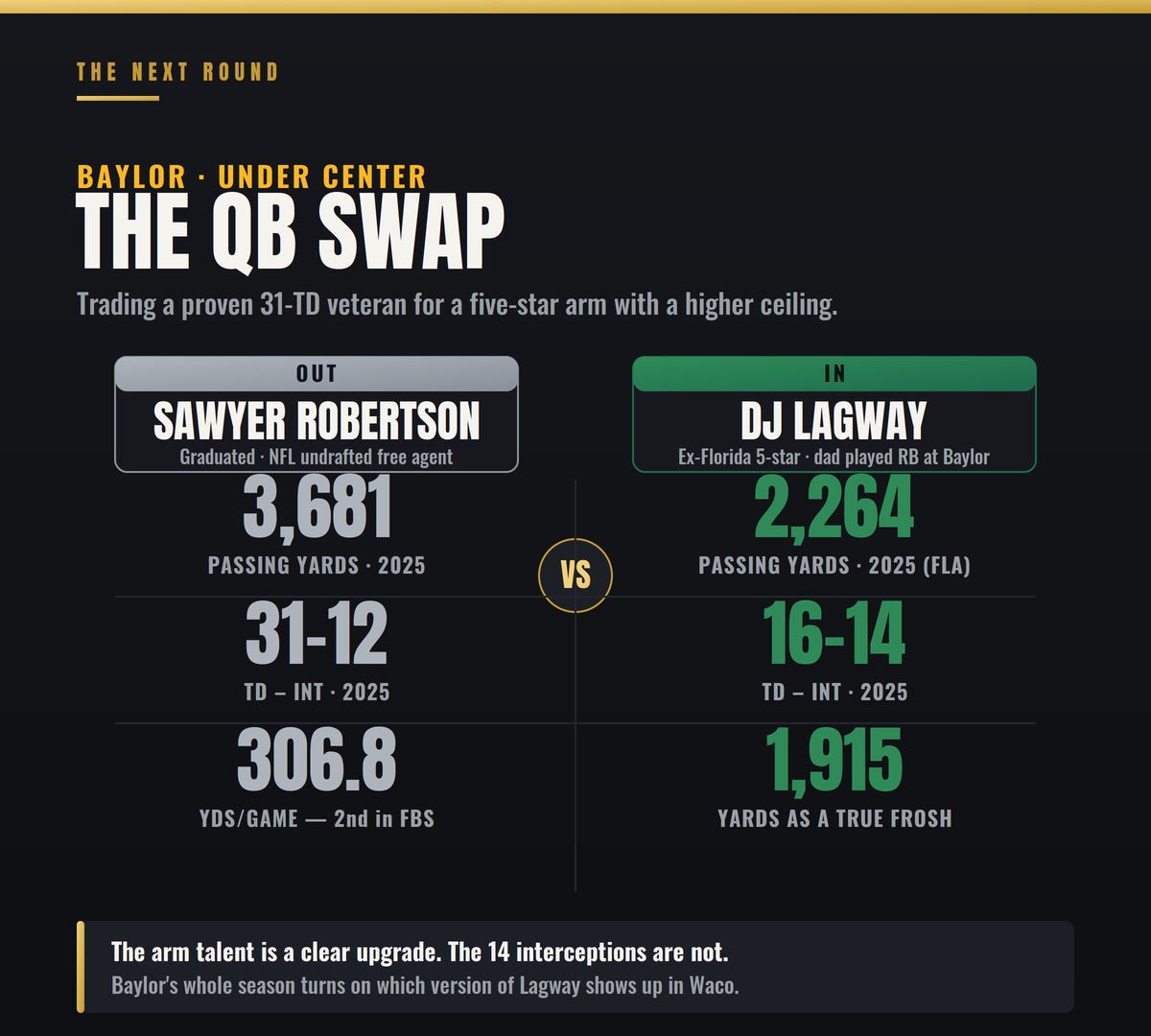
QB Sawyer Robertson graduated (3,681 yards, 31 TD, second in the FBS at 306.8 passing yards per game) and went undrafted, signing as a UDFA.
RB Bryson Washington, the homegrown Central Texas back who ran for 1,000 yards in 2024, left for Auburn — and the schedule wasted no time, handing him a Week 1 reunion against the program that developed him. More on that below.
The entire skill-position core walked: WRs Kole Wilson, Josh Cameron and Ashtyn Hawkins and TE Michael Trigg all departed.
On defense, leading tackler LB Keaton Thomas went to Ole Miss, second-leading tackler Devyn Bobby went to the NFL, OL Coleton Price went to Kentucky, edge Matthew Fobbs-White to Virginia, and S DJ Coleman to Florida.
That is not retooling. That is a new team.
The offense: the most talented Baylor QB since RG3
Here’s why there’s a pulse in Waco anyway. Aranda and OC Jake Spavital landed DJ Lagway, the former Florida five-star and Mr. Football out of Willis, Texas — a player Dave Campbell’s Texas Football called the most talented quarterback to play at Baylor since Robert Griffin III. The fit is almost too neat: Lagway’s father, Derek, played running back at Baylor from 1987 to 1991. Lagway framed the move as coming home and “finding peace” after coaching upheaval in Gainesville.
The talent is genuine. The production is a warning. Lagway threw for 2,264 yards with 16 touchdowns in 2025 — but also 14 interceptions, in an injury-hampered, up-and-down campaign. As a true freshman in 2024 he went for 1,915 yards, 12 touchdowns and nine picks. The arm talent and athleticism are clear; the decision-making is not. Spavital’s entire reputation rests on developing quarterbacks, and this is the test case that defines his — and Aranda’s — fate. If Lagway cuts the turnovers and plays like the recruiting ranking, Baylor has a top-three Big 12 ceiling. If he plays like the 14-interception version, the floor is ugly.