Back to Articles

Inside CFB’s Playoff Prediction

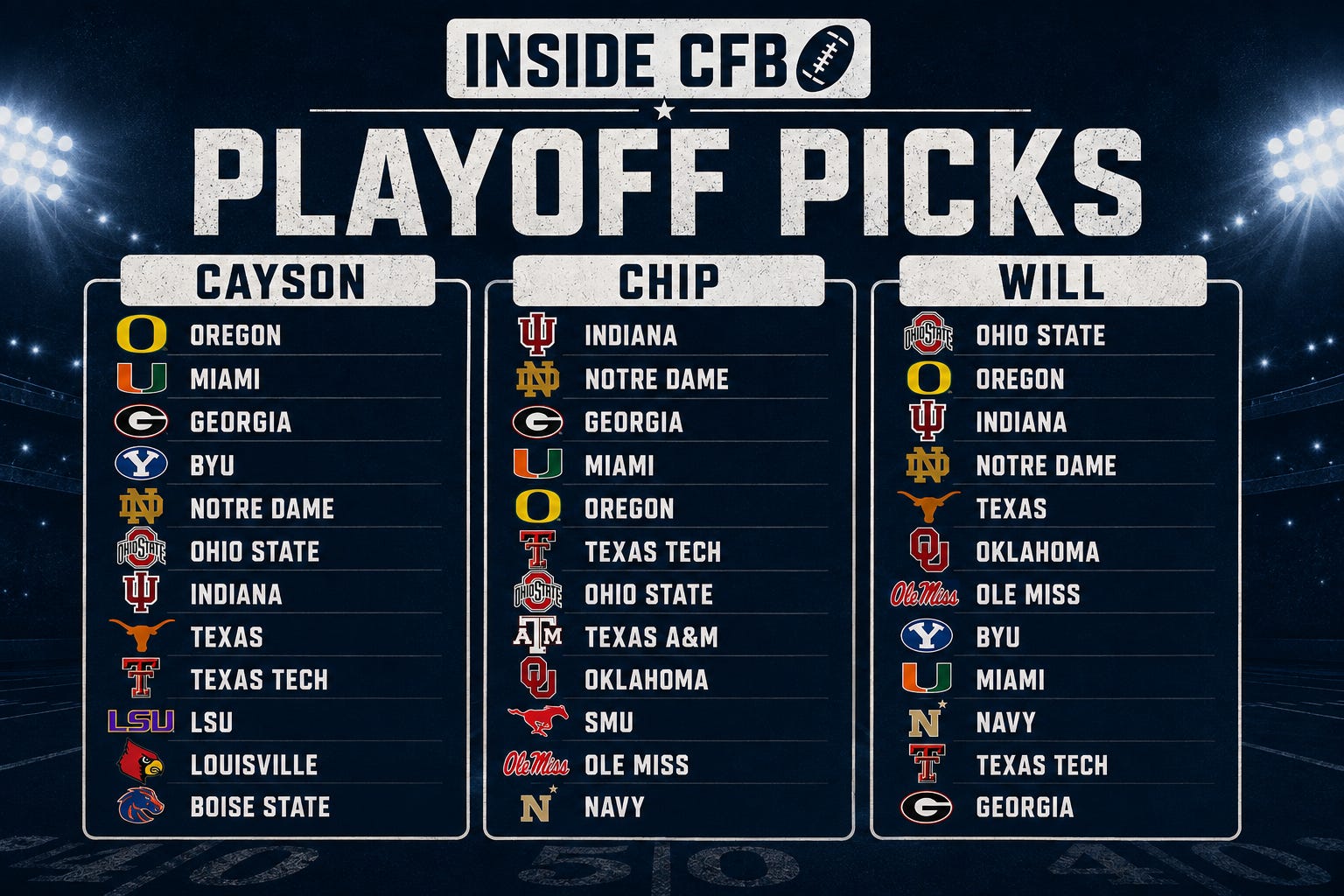
Here's how it worked. Before we turned the microphones on, all three of us submitted a full 12-team College Football Playoff field. Blind. Then we sat down and found out how much we actually disagreed

Inside CFB’s Playoff Prediction

The Seven Nobody Argued About

Chip, Will and Cayson all had the same seven teams:

Oregon · Ohio State · Indiana · Notre Dame · Georgia · Miami · Texas Tech

Three Big Ten teams, the independent, the SEC’s presumed champion, the ACC’s only real contender, and the Big 12’s frontrunner. That’s the chalk, and we’re not going to pretend otherwise.

What’s interesting is what the consensus doesn’t tell you. All three of us have Indiana, Ohio State and Oregon in the field — but only one of those teams can win the league, and the schedule makes that a strange puzzle. Ohio State plays both of them: at Indiana on October 17, then hosting Oregon on November 7. Indiana and Oregon never play each other in the regular season. So the Big Ten’s three best teams sort themselves through one team’s schedule, and the conference title game is very likely a matchup between two teams that have never seen each other.

Chip has Indiana at No. 1 overall. Cayson has them seventh. Same team, six spots apart, and both brackets are internally defensible depending on how you think that October 17 game goes.
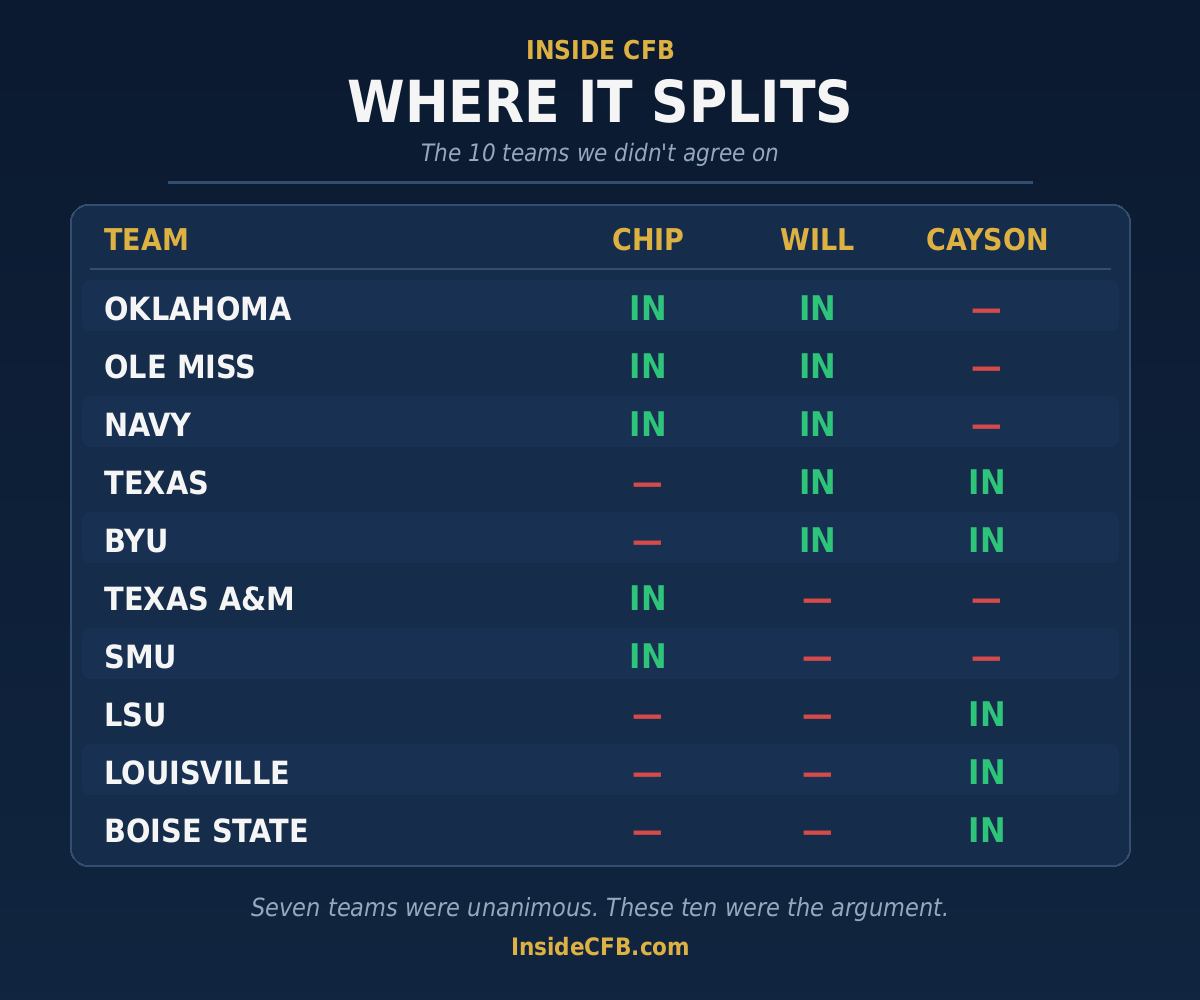
Where It Splits

Five teams made two brackets out of three. Five more made exactly one.

Look at the two rows in the middle. Texas and BYU are on two brackets each, and the guy missing both times is the same guy.

The Texas Argument

Chip has Texas at 9-3 and out of the field entirely. The losses: at home to Ohio State on September 12, then Oklahoma, then Texas A&M.

The case isn’t that Texas is bad. It’s that three losses in that particular order leaves the Longhorns without the kind of November win that a committee can hang a bid on — and the teams beating them are all teams Chip already has in the field. Somebody has to absorb those losses, and Texas drew the short straw.

Will and Cayson both have Texas in, and both make a version of the same argument: the schedule is brutal enough that 9-3 in that league still means something, and the eye test doesn’t care about your win column in December.

Reasonable. But it’s the exact logic that gets a two-loss team from a lesser conference thrown out every year, and you can’t have it both ways.


The Fight That Actually Mattered: BYU vs. Ole Miss

This is where the episode lived for about five minutes.

Chip’s twelfth team is Ole Miss at 9-3. Not in the field: BYU at 11-2.

Yes, you read that correctly. A three-loss team over a two-loss team.

Here’s the BYU construction. Notre Dame goes to Provo on October 17 and wins — that’s the first loss. BYU runs the table otherwise, reaches the Big 12 Championship, and loses to Texas Tech. Final record 11-2, both losses to teams in the field, no shame in either one. And not a single win over a team anybody put in their bracket. The best names on that résumé are Utah, Arizona State, TCU and Iowa State.

Now look at what’s sitting on Ole Miss’s schedule. They go to Texas on October 24. They host Georgia on November 7. They go to Norman to play Oklahoma on November 14. Three swings at a playoff team in a twenty-two day stretch, and they only need to connect on one.

That’s the argument, and it isn’t “9-3 is better than 11-2.” It’s that the committee has never taken the team with the better record over the team that actually beat somebody. Ole Miss has three chances to earn that win. BYU doesn’t get one.

The counter, which both Will and Cayson landed on: you’re assuming Ole Miss goes 1-for-3 in exactly the right spot, and if they go 0-for-3 the whole thing collapses. Fair. It’s also true that a first-year head coach in Pete Golding makes that a shakier bet than it would have been a year ago.

The answer: BYU can go 12-0 in the Big 12 and still never face a test that matters. You can’t hold a team’s schedule against them and then reward another team for a schedule that never asked a question.


The Other Version of the Same Fight: SMU vs. Louisville

The ACC second-team slot is the quieter argument, but it’s the same one wearing different colors.

Chip has SMU at 11-2 — losing at Notre Dame on November 21, then to Miami in the ACC Championship. Cayson has Louisville. Will has neither, which is its own statement about how much he thinks the ACC deserves.

And here the head-to-head is right there on the calendar: SMU goes to Louisville on September 19. Whatever else happens, one of these two owns the other before October, which is more clarity than the BYU–Ole Miss fight will ever get.

The consistency problem is Chip’s, and he knows it. SMU’s résumé is shaped almost exactly like BYU’s — one loss to Notre Dame, one loss in a conference title game, no wins over anybody in the field. If 11-2 with a title-game loss isn’t good enough for BYU, it’s hard to explain why it’s good enough for SMU. The honest version of that answer is that the ACC champion is guaranteed a bid now and the Big 12’s runner-up isn’t, and that’s a rule, not a résumé.

Make of that what you will. It’s the softest spot in the bracket and it deserves to be poked.


Check Back in November

All three brackets are locked and public. We’re revisiting them when the real rankings come out, and somebody is going to look very silly.

Let’s hope I do not regret my Texas pick…


Inside CFB is part of the InsideCFB.com podcast network. New episodes weekly on Spotify. Follow along on Facebook and TikTok.